Showing posts with label New Testament. Show all posts

Thursday, May 21, 2026

Resurrection: Its Fuller and Original Meaning (some hints from critical Biblical Studies)

 (JKK's Notes)


-Julius-Kei Kato, PhD

"Easter" ... You know that this refers to Jesus's resurrection, right? Have you ever wondered what “resurrection” really means … I mean, its full implications? Many think, it simply means that Jesus who was crucified and laid in the tomb just got up and walked out by his own divine power. And this proves his divinity, that he was God-walking-on-earth, so the argument goes. (I'm reminded here of the last scene in Mel Gibson's The Passion of the Christ.) Well, if you thought that was all “resurrection” meant, think again. It's not all that simple.

In these notes, let us deepen our knowledge of Easter and of what resurrection means … in a fuller sense.

SOURCE: I am heavily dependent on New Testament scholar John Dominic Crossan and the various points he makes in his work: Resurrecting Easter: How the West Lost and the East Kept the Original Easter Vision (2018). Other resources mentioned below.


[1] Clarifying Terms: Resurrection vs. Ascension

Many modern Christians—and even some scholars—use the term “resurrection” without understanding its original meaning in the Mediterranean world of Jesus and the first Christians. So, let's clarify first and distinguish between the precise meaning of—what we refer to in English as—"resurrection" with some related but different concepts.

In the first-century Mediterranean world, there was already a widespread belief that special individuals (such as Moses in the Jewish tradition or Romulus for the Roman empire) could be taken up to the divine realm after death. This phenomenon is known as apotheosisa Greek word that literally means "the process of becoming divine." In practice though, apotheosis referred to an extraordinary person being accorded a kind of exaltation or going up into heaven after their earthly lives.

The more proper English words to express what apotheosis means could be: “ascension” or “assumption.” In fact, these words have been appropriated in the Christian tradition to refer to: (1) Jesus' going back up into heaven (ascension) and (2) his mother Mary being "assumed" body and soul into heaven after her death (Mary's assumption). 

However, neither "ascension" nor "assumption" is what the New Testament refers to when it refers to what happened to Jesus after his death on the cross. The New Testament uses the Greek word anastasis (regularly translated as "resurrection"). That word literally means: "to rise", "to stand up."

To summarize:

·       Apotheosis as ascension or assumption is not the same as resurrection.

·       Apotheosis was a common concept across Mediterranean cultures as a way of glorifying special, exceptional people after their earthly existence.

·       Anastasis as Resurrection, by contrast, was not universally accepted in the Mediterranean world. Rather, its use was sectarian. That is, it was used by a sect within Second Temple Judaism.

[2] Resurrection as a Pharisaic, Eschatological Concept

Respected New Testament scholar John Dominic Crossan argues that resurrection (anastasis) in the first century was used specifically by Pharisaic Judaism.

Its meaning was precise:

·       It referred to a future, collective event. This means: Anastasis (resurrection) was not originally an event that happened to an individual. It was a significant, big-time happening that the Pharisees thought would involve a large number of people.

·       Concretely, this is what anastasis referred to: At the end of time, God would:

o   Raise all humanity

o   Conduct final judgment

o   Assign reward or punishment. That eventually came to be understood concretely as “heaven or hell”

If you're a Christian, those concepts will be familiar to you. But now, you know their origins! What you probably don't know is that resurrection was not primarily about an individual returning from death in isolation. Rather, it was primarily about cosmic justice being fulfilled. This belief stood in contrast to another dominant party at the time, the Sadducees, who denied such a future resurrection and were generally aligned with the status quo under Roman rule.

[3] Paul’s Radical Claim in 1 Corinthians 15

It is logical to think that Paul the Apostle (who was a Pharisee before he encountered the risen Christ) uses the term resurrection (anastasis) in this full Pharisaic sense. Therefore, when Paul says that Jesus is raised (1 Corinthians 15), he is making a noteworthy theological claim. (Chronologically speaking, this passage in 1 Corinthians 15 is the earliest mention of the “resurrection,” even before the gospels were written.)

What did Paul mean by saying “Jesus was raised”? He meant that:

·       Jesus’s resurrection is not an isolated event

·       Rather, it is the beginning of the general resurrection of all humanity (It is a collective event)

The essential point about Paul's logic, therefore, is that:

·       Both Jesus’s resurrection and the resurrection of all humans are just one thing: If there is no general resurrection, then there is no (individual) resurrection of Jesus! Try to wrap your minds around that. I’m sure it’s difficult if you are a Western Christian.

·       Conversely: Jesus’s resurrection only makes sense as part of the resurrection of all people at the end of time.

Crucially, JD Crossan argues the following point which might surprise you:

It never occurred to Paul that Jesus could be raised as a special exception (e.g., because he is Messiah or Son of God). Why? If one wanted to claim a unique privilege, the appropriate category to use in Paul’s world would be, as mentioned above, ascension (apotheosis), not resurrection (anastasis).

Monday, April 6, 2026

Reading the Gospels as a Grown-Up: What I Hope My Students Take Away from this New Testament Course


Reflections at the End of the Semester (April 2026)

At the end of every New Testament course I teach, I find myself asking a simple but important question:What do I most want my students to take away from this course? There are many possible answers, but if I had to name one central goal, it would be this:

To learn how to read the New Testament critically, using what I often call the “Three Worlds” approach.


The Three Worlds of the Text


Throughout the course, we worked with a framework that I hope you will carry far beyond this classroom:

  1. World #1: The world within the text – reading the New Testament as literature

  2. World #2: The world behind the text – exploring the historical circumstances that produced it

  3. World #3: The world in front of the text – examining how the text is interpreted and received

This method is not only useful for biblical studies—it can be applied to many areas of life. It teaches us to read a "text" carefully, endeavour to see what has and is going on "behind" that text, and remain aware of how interpretation works. REMEMBER! A "text" in the broadest sense can apply to anything and anyone that has meaning and that can be interpreted! It can refer to a text (in the strict sense) like a book or a "text" (in the broad sense) such as a friend of yours!


Where Our Images of Jesus Come From

Many students enter this course already with a deeply formed image of Jesus and Christianity. For those from Christian backgrounds, that image often comes from the particular Christian church where they were raised, for example, the typical Roman Catholic image of Jesus (for many of us). For others (who were not raised in a church tradition), it comes more indirectly—from Western culture,where Christianity has played a major historical role.

But here is the key insight:

Most of the images we carry of Jesus come from the “world in front of the text.”

These images of Jesus that we have are shaped by:

  • Church traditions

  • Two thousand years of interpretation

  • Cultural influences

In other words, what we “know” about Jesus is already a 2000+year old interpretation of the Christian community (church) and a once-upon-a-time deeply Christian Western society.


Learning to Read More Critically

One of the major goals of this course has been to teach you to engage more deeply with the following two worlds:

  • The world within the text (literary analysis-World #1)

  • The world behind the text (historical study-World #2)

These are dimensions that are often overlooked in everyday religious settings. In the university classroom, however, we intentionally grapple seriously with those frequently overlooked dimensions. We:

  • Study the New Testament as literature

  • Investigate the historical processes that produced it

  • Develop a critical lens rather than passively receiving interpretations


The Shock of Historical Study

For many students—especially those from Christian backgrounds—this leads to a moment of shock.

Why? Because a common assumption that students bring is that the Gospels and Acts are like video recordings of what happened. That is simply NOT TRUE! By the end of the course, however, it becomes clear:

The gospels (and also Acts) are not video recordings. They are already theological interpretations (written in the 70s to the 90s of the first century CE) of the figure of Yeshua of Nazareth who lived in the 20s. 


Consider this:

  • Mark was written roughly 40 years after Jesus

  • Matthew and Luke about 50+ years later

  • John about 60+ years later

Each Gospel reflects decades of interpretation within early Christian communities. This means:

  • The texts are not straightforward historical reports

  • They are shaped by theological aims

  • They include embellishment, creativity, and interpretation


The Gospels as Creative Theology

The authors of the New Testament were not modern historians or journalists. They were:

  • Theologians

  • Preachers

  • Missionaries

Their goal was not really to report what happened, but to proclaim meaning, to proclaim the good news about Jesus, the Christ (aka, the "Kerygma").

At times, this meant:

  • Expanding, reshaping, or embellishing things about Jesus 

  • Even including "made-up" stories about Jesus to convey theological truths. If Jesus created parables using the realities/chracters of his world (such as sheep, wayward sons, mustard seeds, lost coins, etc.) to convey important messages about the reign of God, his earliest followers imitated him by creating "parable-like" stories and teachings about Jesus!

  • Using Jesus as a focal point to communicate their message

Let me repeat for emphasis: Just as Jesus told parables (not literally true but conveying deep truth), early Christians effectively told “parables about Jesus” (embellished or even "made-up" stories).

Thursday, September 24, 2020

[1] A Summary of the History of Christianity: A Paradigm Shift Approach (Part 1)


A Summary of the History of Christianity (by Hans Küng)

(with annotations and revisions done by Julius-Kei Kato)

Part I - the Original Paradigm (#1) : Jesus Christ - Earliest Christianity - the Christian Scriptures 

We will refer to sub-divisions of this article by the section numbers within square brackets (e.g. [1]).

Resources:

Original Link to this Summary (in the public domain / accessed 2020-09-20): https://www.global-ethic-now.de/gen-eng/0b_weltethos-und-religionen/0b-01-02-christentum/0b-01-0201-jesus.php

Paradigm Shifts in Christianity (a one-page visual diagram) https://www.global-ethic-now.de/gen-eng/0b_weltethos-und-religionen/0b-pdf/paradigm-shifts-christianity.pdf

(HIGHLY RECOMMENDED!) Excellent survey by Bishop Richard Holloway of the six major paradigms in Christian history He also has a section at the beginning explaining paradigms and "paradigm shifts." HERE


[1]  Jesus of Nazareth--considered by his disciples as “the Christ” (the Chosen Messiah)

         Place of birth: Bethlehem or Nazareth in Galilee. He grew up in Nazareth. (Historically speaking, ‘grew up in Nazareth’ is a more secure piece of data)

         Year of birth: not after 4 BC, if Jesus was born under King Herod (27–4 BC).

         First public appearance: around the 15th year of Emperor Tiberius (27/28 or 28/29 AD), when he was baptized by John the Baptist.

         Public Life: as a wandering preacher and teacher in the region between Capernaum on the Sea of Galilee and Jerusalem – for a short time (some months?), at best not more than three years, during which time he gathered around himself a circle of disciples.

         Year of Death: He was crucified when he was perhaps in his early 30s, most probably around 30 AD, under Pontius Pilatus (26–30). The exact date cannot be determined.

Christianity takes its name from Jesus of Nazareth who was called by his followers “(the) Christ” (Heb. Moshiach / Gk. christos) meaning “the anointed one.”

Jesus is not a mythical person. His history is situated in Palestine, a province of the Roman empire at the time. He had a short public ministry and then crucified under Rome for political provocation and alleged blasphemy.


[2.1] The Historical Life and Ministry of Jesus of Nazareth

Jesus of Nazareth was a Jew from the peasant class who proclaimed the coming of the Kingdom of God

He lived at a time when many people believed that God was going to let his “kingdom” come.

·         God’s will—he proclaimed—is for people to love God and their neighbour (indeed even their enemies! Matthew 5:44) as they love themselves.

·         Jesus practiced solidarity with everyone who cared to listen and come to his gatherings. He prioritized the disadvantaged, e.g., the poor and the marginalized.

·         The gospels record that he performed many healing actions on behalf of the sick.

·         He sometimes relativized certain Jewish religious laws when he thought that some greater value was at stake, emphasizing that the Law was for the sake of the person and not vice versa.

·         He prophetically provoked the Temple-establishment (the priests, the Sadducee party) and their business interests in the Temple (seen in the ‘purging of the Temple’ incident)

·         He publicly confronted the religious leadership (who were Jews) and the political authorities (who were Romans).

·         For this he was tried and sentenced to death on the cross.

After his death, his disciples had encounters with him that convinced them that he had been raised by God from the dead. This easter faith and proclamation that “Christ has been risen” became the foundation of Christian faith.


[2.2] Jesus Christ – Human and Divine  (this part by JK Kato)

One official doctrine (teaching) regarding Jesus in Christianity is that He is both human and divine. This is the result of decisions made in several important early church councils (particularly, Nicea, Constantinople, and Chalcedon [see below]) in which it was decided that, at the official level, Jesus Christ is to be believed by Christians as “one in essence with the Father” (hence, divine), and “one person having two natures—human and divine.”

It is important though to see how the thinking about Jesus evolved over time as a historical process. We can identify several stages:

  1. ENCOUNTER: When Jesus began his public life, people perceived him first and foremost as some sort of charismatic “Rabbi” (teacher) who taught, healed, and shared fellowship with people, especially the disadvantaged.
  2. MESSIAH? As time went on, some of his followers began to believe that this charismatic rabbi was the MESSIAH who many Jews at the time were waiting for—the one who was going to realize the reign of God in their midst. Jesus also probably thought so about himself. (Note that “Messiah” was NOT EQUAL to “God” in Jesus’ historical context)
  3. POST-RESURRECTION: After Jesus’ death, the resurrection experience made the disciples identify Jesus more and more closely with YHWH, giving him exalted titles: Lord, Son of God, Saviour, Lamb of God, Prince of Peace, etc.
  4. JESUS’ DIVINITY - This process of Jesus becoming more exalted in the thinking of Christians ultimately led (300+ years later) to a radically close identification between God ("YHWH" in the Old Testament) and Jesus as expressed in the faith-statement: Jesus is also divine  (i.e., that Jesus is “God the Son,” “God incarnate,” “the Second Person of the Holy Trinity,” etc. / aka the "deification" of Jesus). This identification happened over a period of time and was made correct and required (“orthodox”) belief only in the 300s of the Common Era or AD. Note that this deification of Jesus Christ is the unique characteristic of Christianity. It is what divides it from Judaism and Islam although the three religions are monotheistic. Christianity claims that it worships ONE God in three persons (Father, Son, and Holy Spirit).
  5. The roots of this belief in Jesus having some sort of divinity are already found in the New Testament – most notably, in the gospel of John.

For a more detailed presentation of related points, see my article “Did Jesus Claim that He Was God?” in: http://www.catholica.com.au/gc4/jkk/016_jkk_240419.php

Monday, August 17, 2020

The Old Testament Plot (“for Dummies”): An Essential Key to Understanding Our New Testament Spiritual Ancestors


Do you want to understand the life and times of Jesus and his followers but realize that you don't know a lot or have forgotten a lot about the Old Testament (the Hebrew Scriptures)? Here's a summary that will be very useful for you as you begin your study of the New Testament (a quick 20-25 minute read!)

Understanding Our Jewish Spiritual Ancestors

     I sometimes refer to the New Testament as a kind of “village” in which some of our "spiritual ancestors" (such as Jesus, Peter, Paul, Matthew, John, etc.) continue to live. When we read, study and reflect on different New Testament texts, we can actually encounter the spiritual ancestors who were responsible for starting the beginnings of the Christian tradition—a tradition that became the foundation of civilizations, cultures, and societies in history, among which is the Western civilization in which we are living today.

     These spiritual ancestors were all first century common era (CE) Jews (with the exception perhaps of “grand-uncle” Luke). As Jews who were born and lived during the time period that historians call “Second Temple Judaism” (from around 515 BCE to 70 CE. Let us also include the immediate aftermath of the Jerusalem temple’s destruction in the years after 70 CE up to the turn of the century), they themselves were heirs of a long and venerable tradition that was already considered “ancient” at the time and therefore even begrudgingly respected in some way by their Roman conquerors. (The Romans had a deep esteem for “antiquity,” that is, traditions that had a long, venerable history.)

     Ancient Jews as a group had several common characteristics that we will have to keep in mind if we are to understand—what can be considered—a common Jewish worldview at the time. How do we do this? By familiarizing ourselves better with some key areas of life as expressed by the following questions:
  • What were the stories, laws, poems, and other oral and written traditions that lay at the foundation of their worldview?
  • What were the dominant religious-cultural symbols and practices that they valued?
  • What were their most cherished hopes and dreams?

Components of the Worldview of Our (New Testament) Spiritual Ancestors

     We will be able to answer these questions by studying what Jews call “TaNaK” or “the Hebrew Bible/Scriptures” or what is widely known among Christians as “The Old Testament” (OT). What this means in practice is that, for Christians and Westerners in general, some knowledge of the OT is necessary in order to get to know their spiritual ancestry. That is why the OT is an essential part of the Christian Bible which, as a whole, is composed of two parts: The Old Testament (which is like a Part 1); and the New Testament (which is tantamount to a Part 2).

     So here are some of the key points (key words will be in bold letters or italics) to keep in mind regarding this Jewish background for us to understand our New Testament village ancestors which, it should be remembered, even include Jesus (as a historical person).

     First of all, ancient Jews were proud that they were part of “Israel” (taken here primarily as a people-nation) which, they believed, had been chosen in a special way by God to be the Creator’s own special people and nation. (Technically, this idea of being chosen is sometimes called divine election.) The people of Israel were bound to God by a special “Covenant,” the primary component of which was the “Law” (Torah) that God had given them through Moses and was, in turn, elaborated upon by the many prophets, sages, and various other teachers throughout Israel’s history. In the Jewish Tradition, it is often said that there are 613 commandments of this “Law” (That number includes the Ten Commandments that are more familiar to Christians).

     Ancient Jews also valued immensely the geographical “Land” (also referred to as “Israel”) which, they believed, God had given to them as Abraham’s descendants. The Land (of Israel) was holy but its cultic center, Jerusalem, was especially so because on it stood the Temple where God—they believed—was present in a special way.

     Moreover, it is also necessary to know the general plot of an extended “sacred story” that—we can say—was the foundation of how our first century Jewish spiritual ancestors understood history or the story of the world. I often refer to it as the “story-plot” or simply “the story” that was told by parents to their children as an essential part of raising them as Jewish and, hence, every Jewish boy or girl at the time would have learned the gist and main lessons of this storyline as they grew up. This was in turn the basis of the worldview by which ancient Jews viewed, understood, and mentally organized everything: God, the world, life itself and all the other details in their world. Having a grasp of the basic flow of this story found in the OT is, therefore, essential for us to understand the common mindset of our spiritual ancestors whose voices are preserved in the New Testament village.

     I divide this extended storyline into several sub-headings using the following key themes. They are: Creation, Nation, Flight, Fight-Settlement, Kingdom(s) and Exile, Return-Rebuilding, Further Struggles with Empires, and Hope. These notions, I think, can summarize well the spirit of the story that parents told their children at the time. This is the same narrative plot that the wider culture expected everyone to know well during what is called Second Temple Judaism.

    This then is the main outline of the extended story that all our spiritual ancestors in the New Testament village were familiar with. (Let me use the “historical present” to narrate the extended plot for vividness.)


The Extended Story-Plot from the Hebrew Scriptures/Old Testament

[Creation] God creates the world and everything in it, culminating in the fashioning of the first humans—male and female— who bear God’s very “image” (Western Christians refer to this as Imago Dei  "God’s image"). The seventh day is special because God rested after all the work of creation. That—it is pointed out—is the origin of the all-important Sabbath practice. The humans are entrusted with the care and stewardship of creation. They are put in an idyllic world described as a garden with the proscription, however, that they should not eat of a forbidden “fruit” (Gen 1-2). The first male and female fail in this, giving in to the prodding of a serpent in the garden, and end up partaking of the forbidden fruit. This event has often been described in Christianity as “the Fall.” This act damages the once perfect relationship between God and humans and, thus, the first ancestors (commonly called “Adam” and “Eve”) are driven away from the garden (Gen 3). They and all their descendants after them are burdened with suffering and eventual death as a result of this disobedience. The point of this story for ancient Jews (as well as those who continue to read this story) is arguably to explain the origin of the many unfortunate things that assail humanity and why evil and suffering are so pervasive in human life. The entry of evil into the human story is portrayed eloquently in the stories that follow in quick succession: Cain (Adam and Eve’s son) murders his brother Abel (Gen 4); in time, the world becomes so evil that God decides to destroy everything and, as it were, restart creation with a clean slate through a flood. God spares a limited number of beings from the flood’s destruction. Thus, Noah and his family and a limited number of species of animals survive the destructive waters by riding out the storm in an ark (Gen 6-9); humans build a tower aiming to “reach the sky” but God confounds their plan by mixing up their languages at Babel (Gen 11), and so forth.

Friday, July 31, 2020

Biblical Study (and any Textual Study!) as a Crime Scene Investigation


Textual Study is Like a Crime Scene Investigation (CSI)

     For years now, I’ve encouraged my students to embark on the enterprise of biblical studies by suggesting that the study of the Bible can be made more interesting and even fun if we imagine it as a “crime scene investigation” (CSI). In this metaphor, the biblical text is tantamount to the “crime scene” (CS); the one who studies, analyzes, and interprets the text is the “crime scene investigator” (CSIr); and the events that led to the creation of the text as we know it now is the “crime.” Let me walk you through the finer points of this image, helpful—I think—for textual study in general and biblical study in particular.

     First of all, when we seek to read and understand the New Testament better (or any piece of literature for that matter), it helps to remember that we are dealing with “texts.” A “text” is usually associated with something written, but that is just one of its possible meanings. We can expand the meaning of “text” to its greatest possible extent. For our purposes here I will define “text” very broadly as “anything that has meaning and that can be interpreted.” When we look at “text” in this way, it will be clear that a text can be practically anything: a written text of course, but also a piece of music, a poem, an historical event, a friend’s facial expression or body language at a given moment, a movie, a work of art, a scene in nature—all of these things can be texts because each of them has a potential meaning and can be interpreted.

     What makes texts (in the wider sense described above) so interesting is that we, who seek to read and understand them, can propose what we think they mean. In short, we can interpret them. Interpretation then is a key notion in biblical studies or any textual study for that matter. Besides, haven’t you noticed that we usually make an effort to interpret the “texts” that are truly important to us? To make a sweeping yet true statement: In order for anyone to understand practically anything at all, we actually have to interpret that very thing. We can therefore say that the activity of interpretation (“hermeneutics” is the fancier word) is a crucially important and essential process not only in textual study but for life itself.

     It is absolutely vital then to learn how to interpret “texts” well so that our understanding of the things that really matter to us in life would be more precise. When it’s a matter of really important things, we do not want to proceed with misunderstandings or illusions. Needless to say, good interpretation is a skill that has to be honed with the right knowledge and the right tools. And that is why I propose the following image for biblical study and interpretation.

     When we've understood the importance of having good interpretation skills and have decided to grapple more seriously with some important “texts” in our life (hopefully, that would include the biblical texts), the image of (biblical) textual study as a CSI, I’ve found, comes in handy for us to better understand what it is exactly we're doing when we study "texts," because it describes as it were “the nuts and bolts” of dissecting a literary text in order to grasp the different nuances of meaning that this text contains.


The Crime Scene (the Text) and the Investigator (the Student)

     In a CSI, the only thing that is accessible to a CSIr is the crime scene itself. The event of the crime—that is, the past happening that produced the crime scene—is (with utter finality!) no longer directly accessible to the CSIr or to anyone else. It has already happened; it is in the past; no one can go back to it barring time travel. When we apply this image to textual study, we see clearly that the event behind a given text is inaccessible to us except through something that we can access now. That often takes the form of a written text or other “mediating” materials such as archaeological remains. What that past event produced is something like a crime scene that is present to us now. This CS is so crucially important for getting a glimpse of what happened in the past and understanding this past event’s different dimensions, that the authorities will try to preserve the CS as it is to the best of their abilities (often by cordoning off and protecting the crime scene) so that the CSIrs could come in and do their job properly and well.

(Additional yet optional nerdiness: that could be an apologia for the importance of the area in biblical studies called textual criticism.)

     Expanding the metaphor and summarizing the discussion thus far, in our case, the biblical reader-interpreter is, as it were, the CSIr who comes to the CS (which is equivalent to the biblical text) and works at the scene by carefully investigating it (an image of textual study). The purpose of this careful study is to thoroughly analyze what is presently available in order to determine as best as possible what might have transpired at the scene in the past which, as we saw, created such a CS in the first place. In other words, the CSIr seeks to get as clear a glimpse as possible of events in the past by analyzing the material remains that they can access now, with all the knowledge, training, and tools at their disposal. Why such a focus on the past? It’s because we hope that understanding the nature of that past event can teach us valuable lessons in the present which will in turn help us forge a better future. 

     Of course, the success or failure of the CSI depends on a lot of factors but, one can say, that it relies in a major way on the competence or lack thereof of the CSIr. If s/he does her work well and thoroughly, that is, observes the CS very carefully, sees the matter from every possible angle, does the requisite background historical research and applies a sharp wit to the analysis of all the available data, then what transpired in the past as the crime will probably successfully come to light. If the CSIr instead does a sloppy job, a less than optimal result might turn out. Of course, it is also quite possible that there are other reasons over which the CSIr has no control, such as, if the crime scene itself has been compromised or if it does not of itself give sufficient evidence of the crime because of a very careful criminal. All these extenuating circumstances could prevent a CSIr from getting to the bottom of the CSI.


Are There Any Witnesses? Internal and External Evidence

     In a conventional crime scene investigation, potential “witnesses” play a crucial, even indispensable role. Many of the crime scenes in the real world and those we see in movies are solved because of key witnesses of the crime who often need protection because they are targets of those who don’t want the truth behind the crime scene to come out.

     Here we have a key difference between a conventional CSI and biblical study. In New Testament studies, we can speak of “internal” and “external” kinds of evidence. Internal evidence refers to the various elements found within the literary work itself: hence, the text itself with its different components such as structure, themes, vocabulary, rhetoric, characters, plot, etc. Working on internal evidence means doing a historical reconstruction of the historical events behind the text based on those “internal” factors.

     “External” evidence instead refers to sources of information outside of the text itself (hence “external”) such as writings of prominent Church Fathers, archaeological discoveries, manuscript evidence that could give us clues about the historical circumstances behind the New Testament book we're trying to understand better. In the history of biblical interpretation, the various statements of prominent early Church Fathers (such as Eusebius of Caesarea, Papias, Irenaeus of Lyon, etc.) about the different writings of the New Testament have traditionally been given much importance.

     However, in contemporary biblical scholarship, the rule of thumb seems to have become: “internal” evidence is weightier than any “external” evidence. Why? It would seem that much of the external evidence concerning the New Testament books is not as reliable as formerly thought because of several reasons such as the historical distance between, say, a Church Father who said this about Mark (for example) and the writing of the gospel itself, or the fact that we can no longer verify the reliability of much of external evidence concerning the New Testament.

     Taking that into consideration, in the present work (the book I'm now writing), we will not rely then on traditional “external” witnesses in order to understand the historical circumstances concerning this or that spiritual ancestor-writer (author) of a particular New Testament book. We will rely primarily on “internal” evidence, that is, what we can say about a New Testament book, its writer and his community, as well as the circumstances that surrounded him - based on an examination of the literary work itself that he left us.


Parallels between Biblical Study and a CSI

     As hinted at earlier, in the crime scene, there is an encounter of past, present, and future. The crime belongs to the past; the crime scene, however, is in the present and acts as a window to the past for the CSIr; the results of the investigation spell out the consequences of the crime for both the present and the future as people draw lessons from the crime. 

     At this point, I hope that the parallels between the textual study of the Bible and a CSI are clear. With such a perspective, we can take up the study of biblical literature with more gusto, imagining ourselves as being on a quest to understand more deeply a past event with such a significance that it changed the lives of our spiritual ancestors by “investigating” a text available to us now.

     Moreover, with such an image of biblical textual study, the many methodologies that students of biblical literature have to learn (such as the historical-critical method, narrative and rhetorical criticism, contextual interpretation, and  many other seemingly mind-boggling methods) can be seen in a new, more interesting light. These different methods can be more deeply appreciated as the necessary rigorous training for them to better deal with the “crime scene” that will stare them in the face every time they investigate a biblical text. This crime scene is waiting to be unlocked in order to yield the riches of a deeper understanding and appreciation of the past and enable them in turn to reap fruits for the present and the future. But that all depends on whether they are competent and good CSIrs.
***
     Making biblical studies interesting is a crucial factor because when that is accomplished, we can argue that at least half of the necessary work will have been done as the students themselves self-motivate to become better investigators of the biblical “crime scene” (the text).


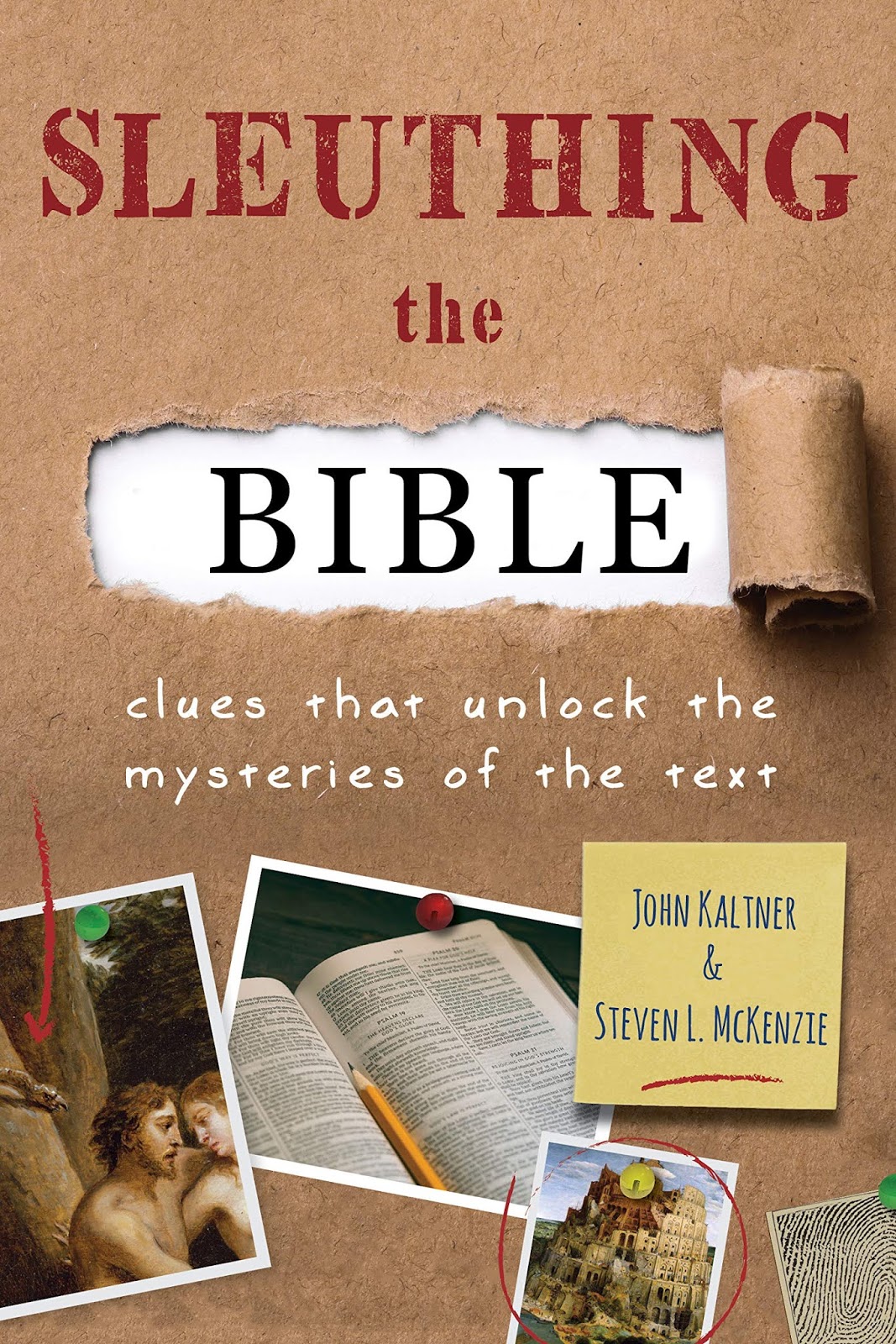
     For more on this kind of approach to biblical studies, I recommend the work Sleuthing the Bible: Clues that Unlock the Mysteries of the Text (2019) by John Kaltner and Steven L. McKenzie.

Sunday, May 31, 2020

Some Useful Links on the Recent State of Research on the Historical Jesus


James McGrath in his Patheos blog says: There has been so much of interest related to the historical Jesus and the Gospels recently that a collection of links with a few quotes and discussions seemed in order. 
https://www.patheos.com/blogs/religionprof/2020/05/historical-jesus-may-2020.html?fbclid=IwAR0rvcHQbqiQIXLm9jsx29ileio2VGfLL-flaLUa6afKta8zlEPlEhgbZ8I


The different links provided by McGrath in this article are really fascinating and, if one is involved in historical Jesus study (as I am), they are worth checking out in detail one by one. This is a note to myself and an encouragement to others!

Friday, May 29, 2020

Book Review: Paul vs. James: The Battle that Shaped Christianity and Changed the World (an historical reconstruction) - by Barrie Wilson PhD


Bibliographical Information
Wilson, Barrie, PhD. Paul vs. James: The Battle that Shaped Christianity and Changed the World (an historical reconstruction). N.p.: CreateSpace Independent Publishing, 2018. 191 pp.
-----

     Recently, I've been consumed by this book by York University (Toronto) Professor-Emeritus Barrie Wilson because it reads like a thrilling, page-turning detective novel but is filled with top-notch historical research, a fruit of Wilson's many years of New Testament scholarship.  I finished reading it promptly. This is a book I highly recommend not only to fellow academics interested in the New Testament, early Christianity, and, specifically, Pauline Studies, but also to everyone interested in a very possible (even probable) imaginative reconstruction of how the early Christians interacted with each other and zeroes in on a crucial conflict between the followers of James' ("the Lord's brother") and those of Paul and his"Christ-worshiping" followers.
     This present historical-fictional work has to be read in tandem with Wilson’s more academic work How Jesus Became Christian (Random House Canada, 2008) where he fleshes out more in detailed prose the fine points of the argument about the origins of Christianity which he presents here in a historical-fictionalized form.
     I've already known earlier, largely through my reading of British New Testament scholar Michael Goulder, that there were "two missions" in the early church (See his A Tale of Two Missions, SCM, 1994 – one of my all-time favourite books of New Testament history!). To put it simply: The dominant one tracing its lineage to the historical Jesus was led by apostolic giants such as James, the Lord’s brother and Jesus’s close companions—Peter and John. It was largely geared toward Jews. It saw itself as a form of Judaism in the style of Yeshua (Jesus) and continued to practice all the Jewish customs in the spirit of Yeshua. The other one was that headed by Paul which, of course, was directed primarily to the gentiles and stood on the revelations that Paul claimed to have had from the Christ himself and was viewed oftentimes as maverick or rogue by some disciples who knew Jesus in the flesh because of its spirit of downplaying Torah and Jewish practices and emphasizing faith in Christ. These two missions did not agree on many things—prominently, about what the continuing significance or irrelevance of “Israel” and Jewish matters were in the light of Jesus, the Christ.
     But this novelized biblical history by Wilson really puts the matter more starkly and more clearly in front of me: There was, he claims, an irreconcilable difference between the "Community of the Way" of James and his followers (among whom the protagonist "Mattai" was included) with the "Christ worshipers" of  Paul and his followers (the leaders of whom were Evodius and Ignatius -yes, THE famous apostolic father Ignatius of Antioch). 
     What Paul was trying to do was to claim that he and his movement were somehow a legitimate "development" of the religion of Israel which, after all, had a pedigree (already then) of at least over a thousand years. This was useful within the Roman Empire where "antiquity" was much respected. Besides, Paul drew converts largely from among the "God-fearers" who were associated with various Jewish synagogues in the Jewish Diaspora. 
     The book is noteworthy because it is an elaborate fleshing out of what the position of James and his followers could have been at the start of the Christian movement. According to Wilson, the followers of Yeshua in the tradition of James ("the Lord's brother") did not want to be associated with Paul's movement and that they sought to clarify at the famous "Council of Jerusalem" (circa 49 CE), that Paul's movement was an altogether different religion from the style of Judaism that Yeshua himself started and was continued by James and all the earliest disciples of Jesus who knew the "flesh and blood" rabbi from Nazareth. 
     In short, Paul was an interloper from the point of view of all the disciples who knew Yeshua because they could not see in Paul's "Christ-worshiping" movement any significant continuity with the style of Judaism advocated by Yeshua. Instead, they thought that Paul's insistence on worshiping Christ as a kind of deity who seeks to achieve an other-worldly kind of salvation through his death and resurrection while dispensing with Torah (the Law) and on everything being mediated directly through the mystical experiences of Paul/Saul himself, was NOT part of the Yeshua movement at all.
     Wow! I'm just being forced to seriously reconsider the earliest history of Christianity in a major way through this work! Kudos, Dr. Wilson for making New Testament studies this intriguing and interesting!

Thursday, May 28, 2020

Book Review: Sleuthing the Bible (by Kaltner and McKenzie)


Kaltner, John and Steven L. McKenzie (2019). Sleuthing the Bible: Clues that Unlock the Mysteries of the Text. Grand Rapids, MI: Eerdmans. 279 pages.

I finished reading through this work. I think that this is an awesomely helpful and fun biblical reference work, particularly because it makes biblical study more interesting by comparing it to a “crime scene” investigation (p. 2). It is all the more significant for me because this is exactly what I’ve been doing about the biblical texts in my classes for the past 14 years as a university instructor. And I thought I was the “originator” of this metaphor for studying the biblical texts (tongue-in-cheek)!

  What is significantly noteworthy about Kaltner and McKenzie’s work is that they go deep into the metaphor of biblical studies-as-detective work and develop it extensively by identifying the most significant clues that could help the biblical detective. They even classify these clues (such as etiology, weird social custom, broken pattern, etc.) into “Smoking Guns” (Part One; clues such as etiology, weird social custom, broken pattern, etc.) and “Dusting for Prints” (Part Two; clues such as anachronism, messy manuscript, perspectival bias, etc.). The former are readily identifiable clues (hence, smoking guns), while the latter needs some careful and more painstaking biblical “detective work” in order for the clue to become more identifiable.

  With the explicit identification of biblical studies as a “crime scene,” the obvious consequence is that the focus and goal of the process decidedly become the possible or probable history behind the text. The biblical text itself is utilized as if it were a crime scene that carries “clues” that a trained eye could identify – clues that could shed light on things that probably happened behind the (crime scene) of the text. This makes the study of the biblical text a fascinating quest to spot different clues that would enable the “investigator” to do a good reconstruction of the past, thus helping us understand the different forces that shaped the creation of the “crime scene” (the text) as we know it today.

  If I could make a suggestion for a future edition, I would say that a good explanation of the different dimensions of the text would even expand the picture and make it more complete. These dimensions are often expressed as “worlds”: namely, the world “of” or “in” the text (the literary work itself); the world “behind” the text (the historical forces behind the creation of the text); and the world “in front of” the text (the reader[s] of the text who interpret the meaning and significance of the text). The different clues of Sleuthing the Bible could then be explained “more globally” in the context of these different worlds as to how they could inform one or another of these dimensions.

  But that does not detract from the fact that this is a very worthy effort to make biblical study more interesting and when that is done, (at least) half of the work has been done. Kudos to the authors for this wonderful aid for biblical studies! (reviewed by jkk)